
Continuous Consumer Research: The Customer Brain Replacing Quarterly Studies in Food and Retail
- Continuous consumer research treats understanding your customers as an ongoing system, not a series of disconnected projects — one grounded model of your consumer that gets more nuanced with every real conversation.
- It is always-on, grounded, and decision-shaped: the model stays active between studies, every insight traces back to a real interview moment, and output is framed as a decision, not a 40-slide deck.
- Food and retail run on a weekly decision clock — by the time a quarterly report lands, customers may have already changed their minds.
- Ungrounded AI simulation is risky: in one study, 48% of AI-estimated coefficients differed significantly from human responses. Grounding on real interviews is what makes the synthetic layer trustworthy.
What is continuous consumer research?
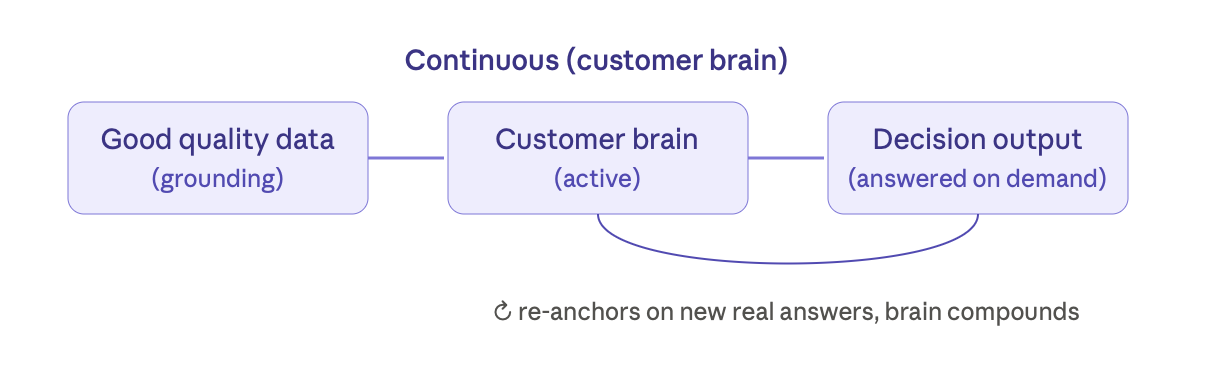
Continuous consumer research treats understanding your customers as an ongoing system, not a series of disconnected projects. Instead of a study that starts, ends, and expires, you keep a single grounded model of your consumer that gets more nuanced every time you talk to a real person and can be employed the moment a decision needs an answer.
Three properties which separate it from traditional research:
- Always-on, not episodic. The model stays active between studies. You do not rebuild context from zero each and every time.
- Grounded, not guessed. Every insight can be traced back to the exact interview moment. Synthetic simulation is a speed layer on top of real signal, never a substitute for it.
- Decision-shaped, not report-shaped. Output is framed as a decision (raise the price here, run a promo there, change this wording) rather than a 40-slide deck to catch up with an hour before the deadline.
Additionally, it should be viewed as a distinct category from the survey and focus-group model. For the broader methodology shift, see Qual at Scale: The New Research Category Replacing Surveys and Focus Groups.
Why is quarterly research too slow for food and retail?
Food and retail run on a short decision clock which the research process should not ignore. Pricing changes, limited-time offers, menu swaps, promotion mechanics, and store-level merchandising can fluctuate within weekly or sometimes even days.
Therefore, quarterly study is not enough. Customers could have already changed their minds, by the time your report lands.
Here is why the mismatch matters:
- A central category or brand team can make dozens of pricing and promotion decisions in a single quarter.
- Traditional custom research takes weeks to field and analyze, so not all decisions are made while having all of the data.
- This leaves room for decisions made on a whim or based on last year's data.
What is a "customer brain" and how is it different from a research repository?
A customer brain can be viewed as a store space of everything you already know about your consumer: real interview transcripts, quantitative waves, behavioral signals, and the persona models built on top of them. It grows with every study. Step by step.
If it sounds to you like a research repository, you are on a good track, but there is one difference which cannot be omitted.
- A repository is passive. It organizes and stores research you already ran.
- A customer brain, on the other hand, is active. It stores what you have learned and goes beyond by answering the questions not already covered by the data.
Over time this value compounds. The longer the brain runs, the more accurate predictions it delivers.
How accurate is synthetic data inside a continuous research program?
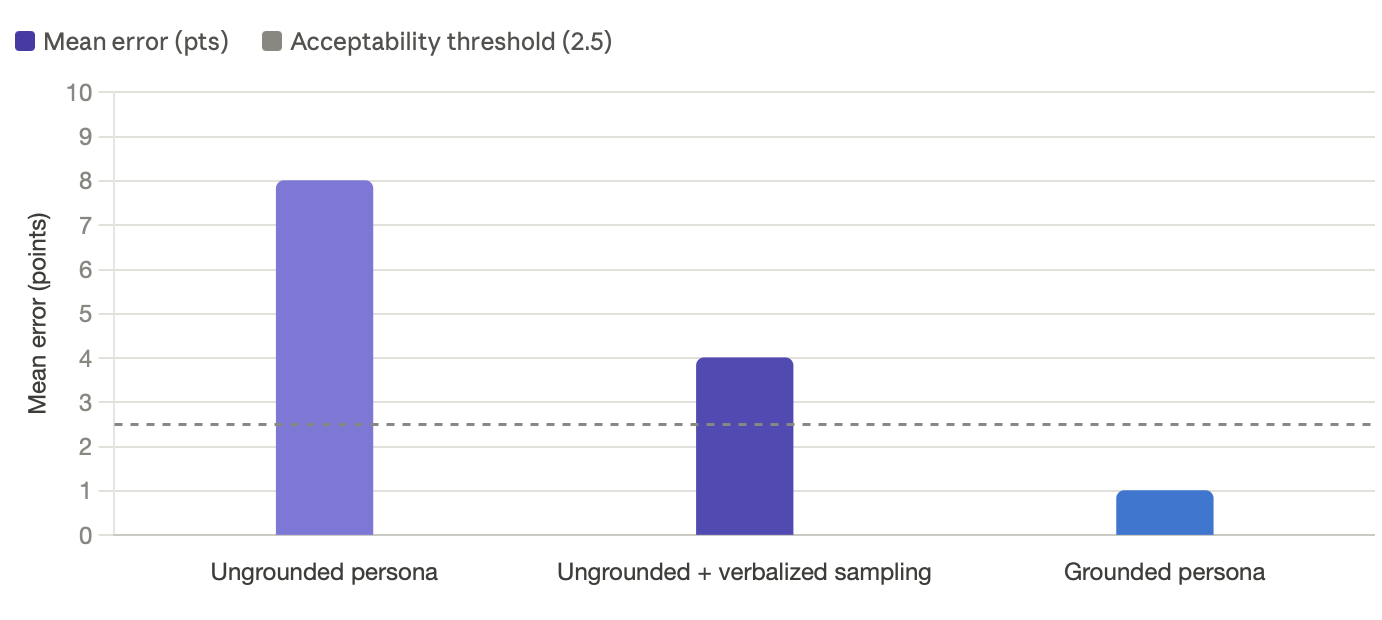
Accuracy is a function of grounding, not whether the method is labeled "synthetic" or "real." Ungrounded simulation is risky; grounded simulation, calibrated on good data, can approach the accuracy of a real study.
The evidence for that risk, from Bisbee et al. (2024), comparing ChatGPT-generated survey responses to real American National Election Study data:
- 48% of estimated coefficients differed significantly from human responses
- Of those, the effect's direction flipped 32% of the time; meaning ungrounded AI pointed the wrong way in roughly a third of cases
- Responses showed less variation than real survey answers
- Results shifted substantially with small changes in prompt wording, or even when rerun 3 months later
That instability is expected in a one-off "ask AI" query, but far less likely in a grounded, continuously-updated model built for exactly this purpose.
How do you start a continuous consumer research program?
Simple progressive outline:
- Pick one decision loop with high frequency. Pricing or promotion at a single location or product line is ideal, due to the short feedback cycle.
- Ground it in real interviews first. Run a real qualitative to provide a quantitative baseline, serving as a foundation for the model. Do not skip this step, under any circumstances.
- Layer synthetic simulation on top for speed. Once grounded, use calibrated simulation to explore variations between real waves, and re-anchor on real people to prevent drifting.
- Shape the output as decisions, not dashboards. Every result should end in a recommendation someone can act in a short time period.
- Let the brain compound. Keep every wave in one place so subsequent months are far richer than previous ones.
Curious what a customer brain would look like for your category? Book a pilot walkthrough or see Reason8 in action.
Reference: Bisbee, J., Clinton, J. D., Dorff, C., Kenkel, B., & Larson, J. M. (2024). Synthetic replacements for human survey data? The perils of large language models. Political Analysis, 32(4), 401–416. https://doi.org/10.1017/pan.2024.5
| Dimension | Quarterly / project research | Continuous customer brain |
|---|---|---|
| Cadence | Episodic — starts, ends, expires | Always-on between studies |
| Context | Rebuilt from zero each project | Compounds with every wave |
| Source of truth | Latest report (often stale) | Grounded model traced to real interview moments |
| Synthetic simulation | One-off "ask AI" queries, unstable | Speed layer calibrated on real signal, re-anchored on real people |
| Output | Report-shaped (40-slide deck) | Decision-shaped recommendation |
| Fit for food & retail clock | Weeks behind weekly decisions | Answers the moment a decision needs one |
What is continuous consumer research?
It is an always-on approach where you maintain a single grounded model of your customer. It gets updated by qualitative and quantitative data you have collected and further expanded by synthetic simulation.
Is continuous research the same as a research repository?
No. A repository passively stores and organizes research you already ran. A continuous customer brain also goes and gets new answers on demand with real people, and stays current rather than reflecting only your last project.
How accurate is the synthetic part?
Accuracy depends on grounding. Ungrounded simulation can be off by large margins and sometimes points the wrong way entirely (Bisbee et al., 2024). Grounded simulation, based on real answers, can approach results comparable with a real study on calibrated questions.
Which industries benefit most?
Categories with high decision frequency: food, beverage, quick-service restaurants, retail, and consumer packaged goods, especially central or headquarters teams that manage many products and make pricing and promotion calls almost every week.