

How Skawa Chose the Packaging They Never Would Have Picked
How one of Poland's oldest sweets brands stopped deciding by gut feel - and why the design that came out of the research wasn't the one sitting in the boardroom as the favorite.
600
Consumers
3
Phases in one cycle
1 week
vs. the standard quarter
Summary of Impact
Skawa replaced internal intuition with the voice of 600 consumers - to choose its new packaging.
The design the company had quietly settled on as the natural winner lost on every strategic metric: premium perception, modernity, shelf standout.
Three research phases - quantitative screening, qualitative deep dive, and final validation - delivered in a single cycle, in one week, instead of the standard quarter.
The Context
Skawa is one of the oldest Polish confectionery brands. Biscuits that many Poles remember from their grandmother's kitchen. The kind of emotional capital a company three times its size would envy.
And that capital was exactly the trap.
When a brand carries more than a century of heritage, decisions about the product naturally feel personal - made the way important family decisions are made: around the table, with care, with deep knowledge of who the brand is and what fits it. A new pack, a new format, a new flavor - all carried by the instincts of people who know the company inside out.
That kind of intuition is a real asset. It's hard to build, and impossible to fake. The only thing it can't do is sit at the shelf and pick up the pack. That's where the consumer comes in - and what the consumer sees doesn't always match what the brand sees of itself.
There's a lot of brand knowledge inside this company, and a lot of conviction - both built up by being close to Skawa for a long time. But you can spend thirty years in this business and still be surprised by what consumers actually see. That's not a failure of intuition. It's the nature of being on this side of the shelf. So we wanted to let the consumer take a seat at the table too. Not to outvote us. To talk to us.
The Challenge: Four Designs, One Decision, Zero Certainty
Skawa was choosing packaging for the next generation of its biscuits. Four designs were on the table - ranging from the most classic, “the way it's always been”, to a distinctly modern one.
Inside the company, consensus formed fast. The favorite was the design that sounded safe, familiar, uncontroversial. Everyone at the table knew why: because Skawa had looked like this for decades. Because that pack wouldn't scare off the loyal shopper who'd been reaching for these biscuits for thirty years.
Except no one at the table was that shopper. And no one at the table was the new consumer the brand was trying to win, either.
Every packaging choice is a small bet on what the shopper will see. A safe design makes one bet. A confident design makes another. We didn't want to place that bet without knowing what the shopper was actually looking at.
We had a specific design in mind - one we were ready to move forward with. But then it hit us: the consumer is changing faster than ever, and we couldn't make this call based on what we thought they'd want. We had to hear it from them directly - and we needed that answer fast.
The Solution: 600 Consumers, Three Phases, one week
Reason8 designed a three-phase study for Skawa. Each phase answered a different question - and each de-risked the decision from a different angle.
Phase 1 - quantitative screening. MaxDiff methodology: instead of asking consumers whether they like each design (to which most reply “they're all basically fine”), we force them to pick the best and the worst across six dimensions - from premium perception to ingredient communication. The result: two clear winners, two clear eliminations.
Phase 2 - in-depth qualitative interviews. 40-minute conversations, moderated by Reason8 - that react to what the consumer just said. The question wasn't “which is better”. The question was why. What do consumers see that we don't. What associations they have with color, with typography, with the heart motif. What frustrates them about the packs already on the market.
Phase 3 - validation on a representative sample. Each respondent assessed only one of the two winning designs, under conditions close to a real shelf decision. Price, purchase intent, risk of cannibalizing Skawa's existing products.
Three phases. 600 people. One week.
Honestly, when we started this I had three months in my head, maybe more - that's just how long this kind of research takes. Somewhere along the way the timeline tightened on us. We realized the decision was actually sitting on our desk, and we needed an answer within a week. I was bracing to make the call without the data. That's when we brought Reason8 in. We told them where we stood, they told us they could deliver in a couple of days. We took the bet. And they did. Without that, we'd have made a completely different call - the one our gut was already pointing us toward. The research itself ended up showing us that the call would have been wrong. We'd have launched the wrong design, and we wouldn't have known.
The Moment the Data Broke the Consensus
Phase one already gave us pause. Phase two - the deep-dive interviews - flipped the conversation.
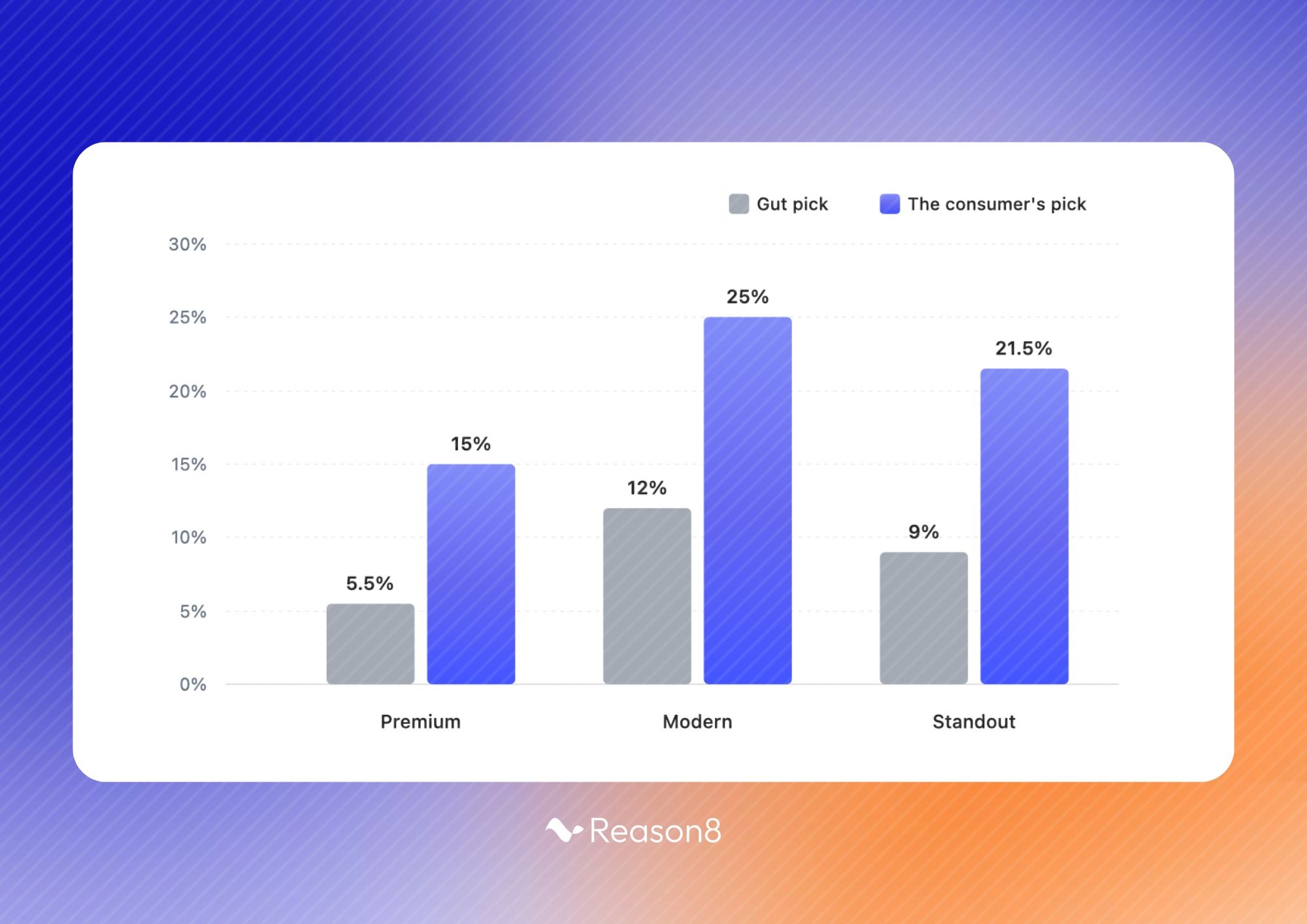
Consumers, regardless of age group, were seeing something different on those packs than the people inside Skawa. The design the company considered “safe” was indeed perceived as traditional and familiar - but also as ordinary, unremarkable, not the kind of pack that signals a product worth paying more for. The design that had been tagged internally as “risky” turned out to be seen as modern more than twice as often (25% vs 12%), as standout twice as often (21.5% vs 9%), and as premium nearly three times as often (15% vs 5.5%).
And the heart shaped from biscuits - the element most argued about around the table - turned out to be the one consumers read as “someone put their heart into this.”
The Decision Intuition Wouldn't Have Made
Skawa is rolling out the design it never would have chosen on its own.
Not because someone changed their mind overnight. Because 600 people - across three independent phases - showed one consistent picture: this design more effectively builds a premium image, stands out better on the shelf, drives stronger purchase intent, and does so across every key age group.
This isn't a decision against tradition. It's a decision for tradition, said in a new language. Because the heart motif, the warm palette, and the quality cue aren't a break with Skawa's DNA - they're its contemporary translation.
We know our brand - built up over a century. What changes faster than the brand is the consumer, and the market around them. The decisions that deliver the biggest return are built on what consumers are saying today, not on what was true last year. Research at this speed lets us hear them in time to act.
What the Research Left Behind, Beyond the Pack
Skawa walked into this project with a packaging decision on the table. Sitting underneath it was a longer list of questions the team had been working through for some time - which frustrations shoppers in this category quietly put up with, which packaging tweaks would matter most day to day, which directions for new flavors and formats consumers are waiting for, and which ones they aren't.
Like most consumer-goods teams, Skawa had been answering those questions from a mix of sales data, internal hypotheses, and the kind of instinct that comes from a century in the business.
The conversations did both. They surfaced the category frustrations consumers had quietly stopped expecting anyone to solve. They pointed to specific ways the pack itself could work better in everyday use. They drew a sharp line between the directions consumers were quietly waiting for and the ones they were not.
Skawa is working through all of it internally. The point of telling this story isn't to list the answers - it's that the research uncovered them, in the same cycle and on the same budget as the headline packaging decision.
You usually pick between scale and depth. This time we didn't have to. 600 consumers gave us the scale to trust the answer. Reason8's AI-moderated interviews gave us the depth to act on it. Together they change what research can do.
Underneath all of it: Skawa came out of this project with a new way to test its convictions against the consumer in real time. It knows how fast that conversation can happen, and it knows what it adds to the kind of judgment Skawa has always brought to its decisions.
At this depth and this speed, consumer input stops being a sense-check on a decision. It becomes part of it. And that's where the return lives - in decisions that fit the market, not just the room.
Curious what your decision would look like if you actually asked the consumers?
Reason8 runs in-depth consumer research at a scale that wasn't available before - at a speed that matches the pace of your decisions.