
What Is MaxDiff Analysis? A 2026 Guide to Best-Worst Scaling (and How to Run It in a Day)
- MaxDiff (maximum difference scaling, also called best-worst scaling) is a survey method where respondents repeatedly pick the best and worst item from small sets, instead of rating each item on a scale.
- Because it forces trade-offs, MaxDiff produces a clear, ranked, interval-scaled priority list and avoids the "everything is a 5" problem that flattens rating-scale data.
- In head-to-head tests it discriminates roughly twice as hard as rating scales (average t-statistic 7.7 vs 3.3, per Sawtooth Software).
- With AI-moderated fielding and grounded consumer samples, a full MaxDiff study now takes 1 day instead of a quarter.
What is MaxDiff analysis?
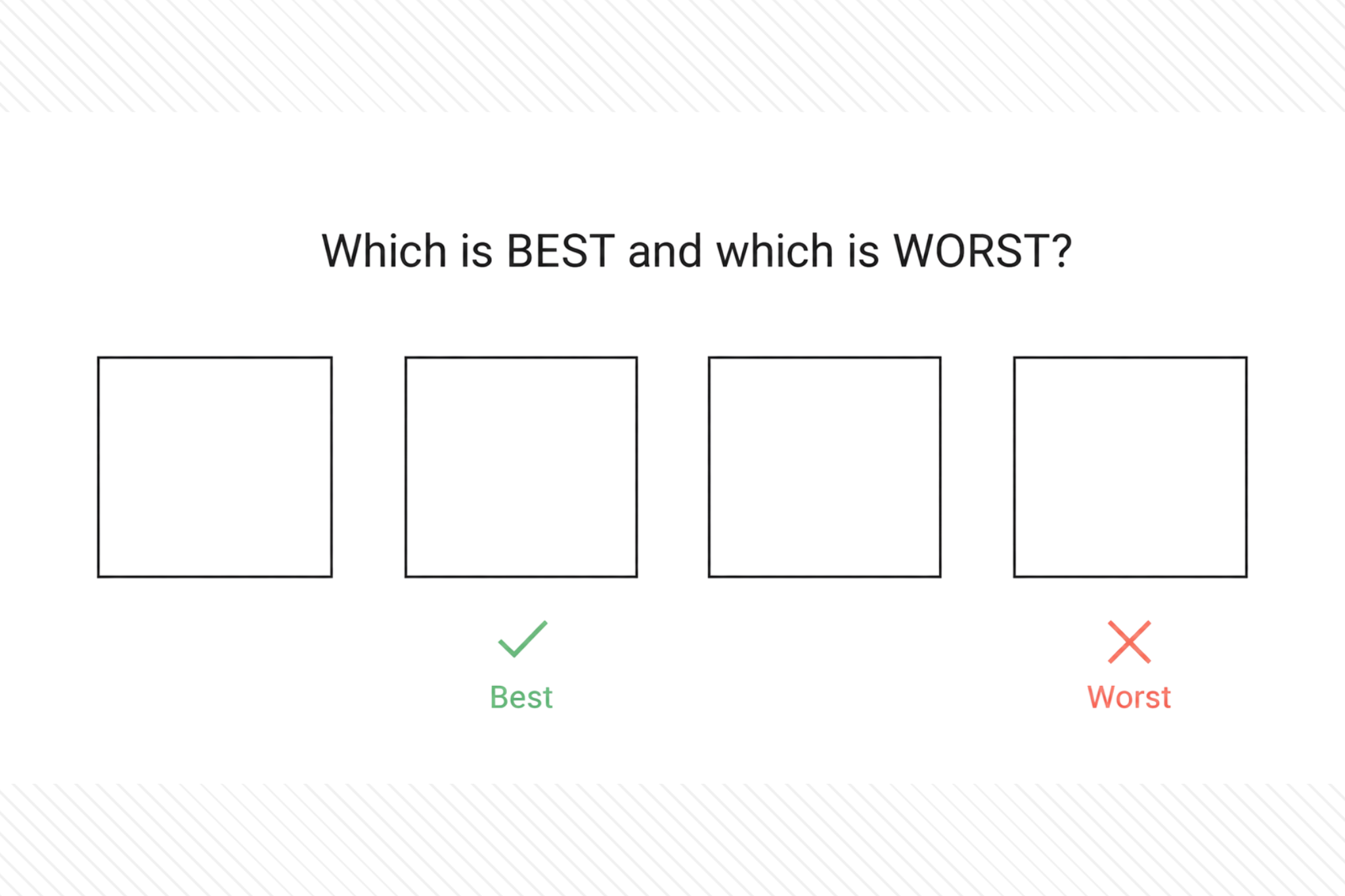
MaxDiff is a way to measure how much people prefer or prioritize a list of things: product features, messages, packaging claims, benefits, brand attributes, or menu items. Instead of asking "rate each of these from 1 to 5," MaxDiff shows a respondent a small subset (usually 4 to 5 items) and asks two questions: which is best (most important, most appealing) and which is worst. Then it shows another subset, and another, rotating the items so each one appears several times.
From those forced choices, a model reconstructs a full ranked list for every item, on a common interval scale, with clear distances between items. You do not just learn the order. You learn how far ahead the winner is and where the real cliffs are.
It is one of the most widely used prioritization techniques in modern market research precisely because the output is decision-shaped: a priority list you can act on, not a wall of near-identical averages.
Why not just use a rating scale?
Because rating scales lie to you politely. Three well-documented biases wreck them:
- Ask someone to rate 12 features and most come back as 4s and 5s. Everything is "important," so nothing is prioritized.
- People use scales differently. Some are generous, some are harsh, and this varies sharply across cultures, which quietly poisons any multi-market study.
- Respondents drift toward agreeing, inflating everything upward.
MaxDiff sidesteps all three. There is no scale to over-use, and a respondent cannot call everything the best. They must choose.
How does MaxDiff work?
- Build the item list. Each needs to be a clean, comparable, standalone statement.
- Generate an experimental design so every item shows up an equal number of times and pairs are balanced. In a typical design each item appears 2 to 4 times per respondent.
- Each respondent sees a series of screens, picking best and worst on each.
- Estimate scores turning the individual best/worst choices into interval-scaled utility scores per item, per respondent, that sum to a comparable scale.
- You get a ranked list, showing not just order but the size of the gaps.
The raw results of a maxdiff question may look like this:
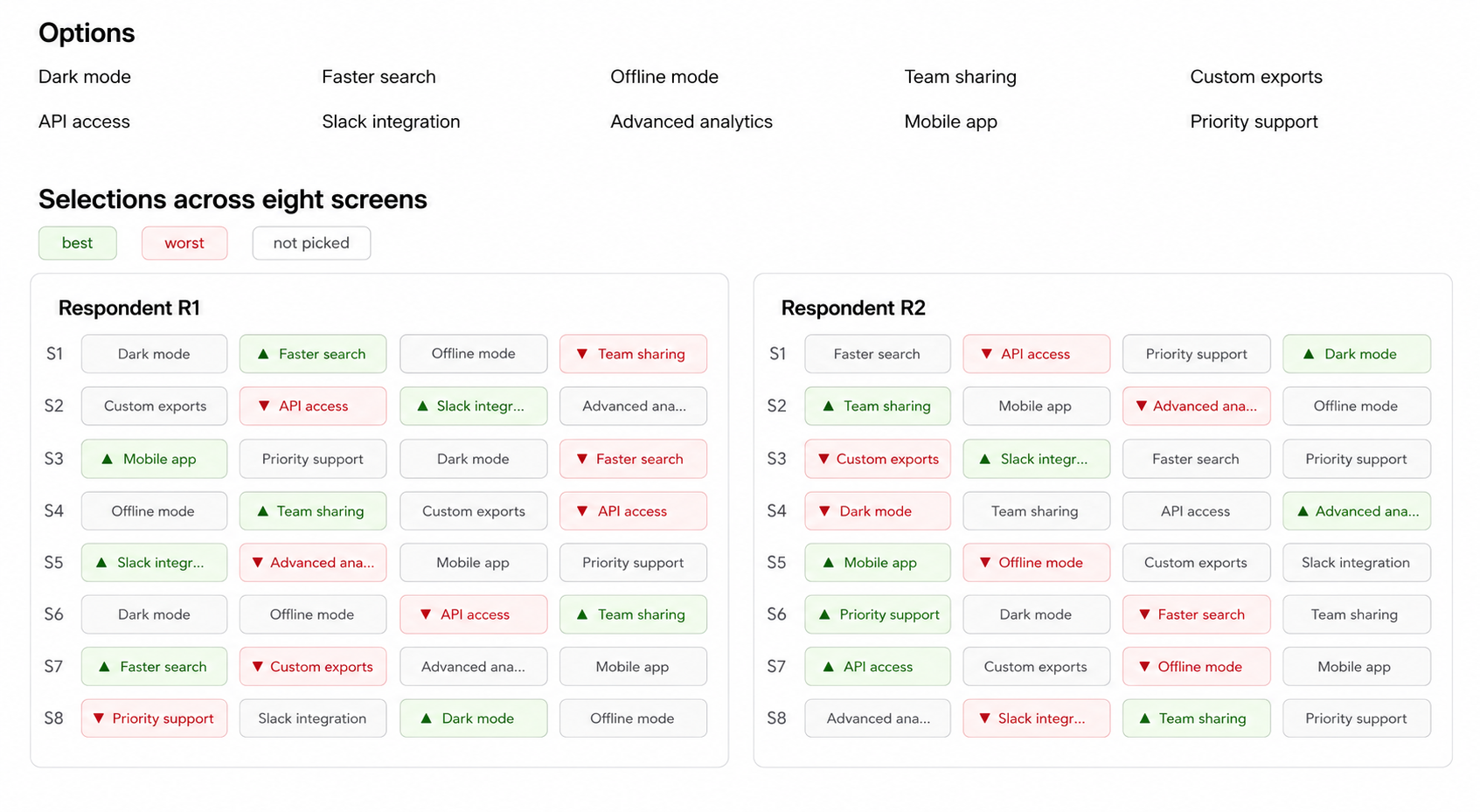
Here's what happens between "people click things" and "you get a ranked list":
- For every item, count how many times it got picked as best, and how many times as worst, across every respondent and every screen it appeared on.
- The simplest version: net score = (times picked best) minus (times picked worst). Items picked best often and worst rarely rise to the top.
- Rotation isn't perfectly even, so divide by how many times each item was actually shown, so items shown more often don't get an unfair edge.
- A raw count is a decent rough ranking, but real MaxDiff scoring builds a small model per respondent instead — it estimates how much that person prefers each item relative to the others, factoring in which items it was competing against on each screen.
- Borrow strength across people. No single respondent sees enough combinations to fully rank 20 to 30 items alone. The model shares signal across all respondents: if most people clearly prefer item A over item B, that nudges an individual's own uncertain A-vs-B ranking in the same direction, without overriding what they actually picked.
- Rescale to a 0–100 "share of preference." The final per-item score is converted so all items sum to 100. Read it like a percentage: if this item were up against every other item, X% of the time it would be picked as best.
That is why MaxDiff hands you both an order (item 3 beats item 7) and a magnitude (item 3 beats item 7 by a lot, but items 7 and 8 are basically tied).
The forced trade-off is the whole point. Every "best" pick costs the respondent the chance to pick something else, which is exactly the constraint real customers face at the shelf, in the app, or on a pricing page.
When should you run a MaxDiff study?
MaxDiff earns its keep whenever you have too many good options and must choose a few:
- Feature and roadmap prioritization (which capabilities matter most to which segment)
- Message and claim testing (which value proposition to lead with)
- Packaging and concept screening (which design reads as premium, modern, standout)
- Menu, assortment, and range decisions (what to keep, cut, or feature)
- Brand attribute importance (what actually drives choice)
A concrete example: a century-old confectionery brand had four packaging designs and a room that had quietly converged on the safe, familiar one. Running a MaxDiff screen across 600 consumers (as the quantitative first phase of a study) showed the "risky" design read as most premium nearly 3x more often (15% vs 5.5%) and most modern 2x more often (25% vs 12%). Without the forced trade-off, the rating scale would have called all four "appealing" and the team would have shipped the weaker pack.
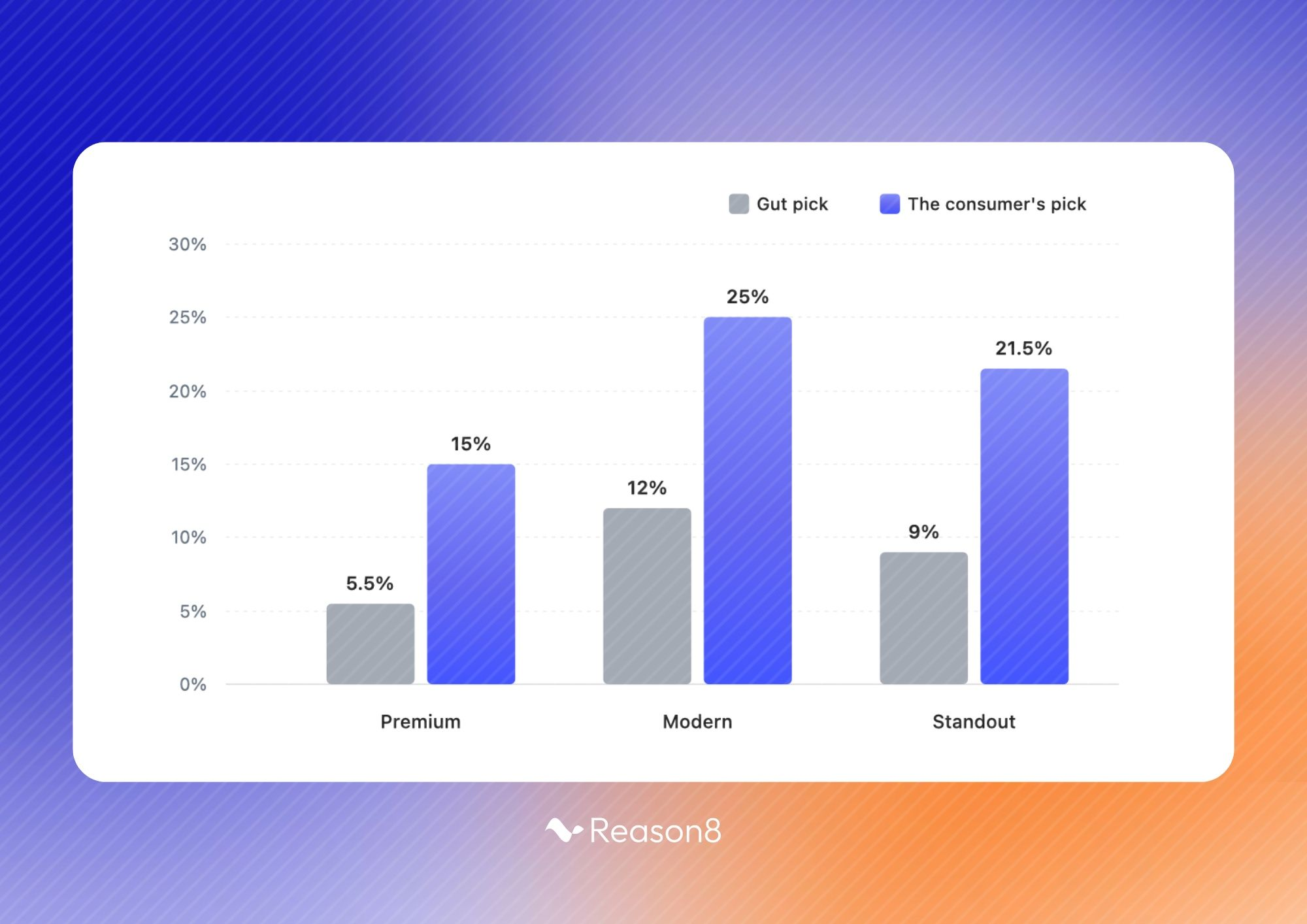
You can read more about this case study here: reason8.io/case-study/skawa
When the deliverable is a priority order you will bet a budget on, use MaxDiff. When you just need a rough pulse or a long-running tracker, a rating scale is fine.
How does AI change MaxDiff in 2026?
First, speed: AI-moderated fielding and automated design collapse a study that used to take a quarter into days, without giving up the balanced design or the hierarchical-Bayes scoring that make MaxDiff rigorous.
Second, and more important, who is answering, and how. MaxDiff is usually run as a purely quantitative exercise, which makes it an easy target for the same problem every quantitative panel runs into: click-farm bots and low-effort panelists clicking through screens without ever engaging with the trade-off.
In qual at scale, Reason8 verifies that a real person is behind every response, not a bot cycling through your survey link, so the ranking you get reflects trade-offs actual people made. On top of that, you can layer in qualitative signal from the same respondents and aggregate it alongside the MaxDiff scores, so the ranked list comes with the reasoning behind it, not just the order.
MaxDiff is live on Reason8
Most teams have more ideas than they can build. MaxDiff shows you which ones are worth investing in.
MaxDiff is available to Reason8 users today.
| Dimension | MaxDiff (best-worst) | Rating scale (1–5 / 1–7) | Constant sum (allocate 100 points) |
|---|---|---|---|
| What it asks | Pick best and worst from small sets | Score each item independently | Split a fixed budget across items |
| Forces trade-offs? | Yes | No | Yes, but cognitively heavy |
| Discrimination among items | High (avg t 7.7) | Low (avg t 3.3), lots of ties | Medium, degrades past ~6 items |
| Scale-use / culture bias | Removed | Strong | Reduced |
| Respondent effort | Low per screen | Very low | High (math) |
| Best for | Prioritizing 10–30 items into a clear ranking | Quick temperature checks, tracking | Small item lists where magnitude matters |
Is MaxDiff the same as best-worst scaling?
Yes. MaxDiff (maximum difference scaling) is the most common form of best-worst scaling, sometimes called Case 1 best-worst. The terms are used interchangeably in market research.
How is MaxDiff different from conjoint analysis?
MaxDiff prioritizes a list of independent items (features, messages, claims). Conjoint measures how people trade off attributes that vary together inside a full product configuration, and can model price and share. Use MaxDiff to rank what matters; use conjoint to design and price the bundle.
How many items can I test in one MaxDiff study?
Commonly 10 to 30. You can go lower or higher with sparse or express designs, but each item must appear enough times across respondents to be estimated reliably, so more items means more screens or more sample.
Does MaxDiff give me the importance magnitude or just the order?
Both. Scores are interval-scaled (often rescaled 0 to 100), so you see the ranking and the size of the gaps between items, not just their sequence.
Can MaxDiff be run with synthetic respondents?
Technically yes, but with caution. The most important thing is grounding, which can only be performed well in the forward deployed research model. Without proper grounding, synthetic panels can approximate familiar patterns and fall apart on novel trade-offs. Ground the study in real consumers for any decision you will spend real budget on.